
Ministers discussed trade, supply chains and predictable trade pathways.
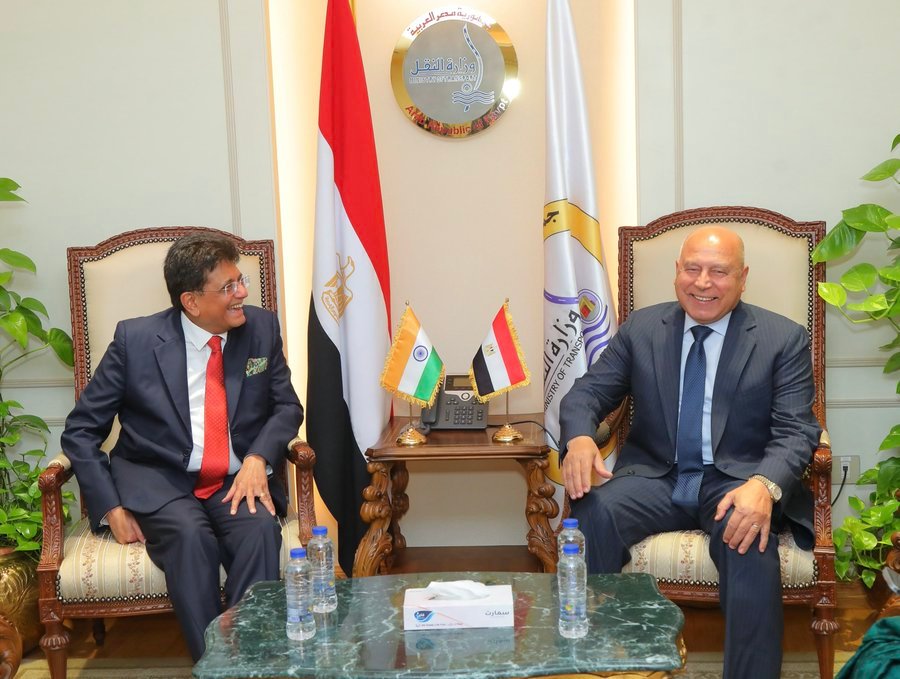
Minister of Commerce and Industry Piyush Goyal and Dr Mohamed Farid Saleh, Minister of Investment and Foreign Trade of Egypt, have reaffirmed their commitment to expanding bilateral trade, with a target of US$12 billion.
The Ministers emphasised the need to diversify trade, promote value-added exports and address trade-related challenges at the 7th session of the India–Egypt Joint Trade Committee (JTC) in Egypt’s New Administrative Capital on 16 Nov.
The meeting marked the first occasion on which this important bilateral institutional mechanism was convened at the ministerial level, underscoring the priority both governments attach to strengthening the economic dimension of the India–Egypt Strategic Partnership.
As a key outcome of the 7th Joint Trade Committee meeting, both Ministers agreed to establish a Joint Working Group to explore the Terms of Reference for a Preferential Trade Agreement or Free Trade Agreement to facilitate stronger bilateral trade, improve access to both markets and promote investment linkages between the two countries.
The meeting was preceded by bilateral discussions between the two Ministers on expanding trade, facilitating investments and developing long-term industrial and commercial linkages. The JTC provided an opportunity to review existing trade ties, assess challenges faced by businesses and identify new areas for closer collaboration.
The Committee reviewed the growth in India–Egypt trade, which increased by 35% to reach USD6.5 billion in FY 2025-26 (April 2025–March 2026). Trade during April–September 2026 also grew by 65% to reach USD5.04 billion, compared to USD3.08 billion during the corresponding period in 2025. The increase reflects the growing momentum in commercial exchanges and the potential for further diversification of the trade basket. Significant complementarities exist for enhanced trade in industrial goods, energy and fertilisers, chemicals, pharmaceuticals, engineering, textiles and agricultural products.
The discussions primarily focused on expanding trade, developing supply chains and establishing predictable trade pathways. Both sides considered measures to address non-tariff barriers, facilitate customs processes, strengthen standards and conformity assessment, and improve market access. They also discussed practical issues affecting business operations, including product registrations and trade-related regulatory procedures, the Ministry of Commerce and Industry said in a release from New Delhi.
Discussions also focused on strengthening business exchanges and encouraging joint manufacturing and investment. Priority sectors included pharmaceuticals and medical devices, engineering and electrical equipment, fertilisers, textiles, renewable energy and emerging technologies. Opportunities for Indian investment in Egyptian industrial zones, as well as Egyptian investment in India’s expanding manufacturing and services sectors, also formed an important part of the agenda.
Both sides expressed interest in strengthening the framework agreement between Invest India and Egypt’s General Authority for Investment and Free Zones, including a proposed digital platform for sharing investment information and facilitating business linkages.
Egypt’s proximity to the Suez Canal and its connectivity with African, Arab and European markets make it a valuable partner for export-oriented manufacturing and regional supply chains. India, in turn, offers Egyptian investors and exporters a large and dynamic market, increasingly competitive infrastructure and opportunities for technology and production partnerships.
Speaking at the Joint Trade Committee meeting, Piyush Goyal highlighted five areas of strong complementarity between India and Egypt: pharmaceuticals and healthcare, leveraging India’s strengths in affordable medicines, vaccines and medical technology; engineering and automobiles, covering machinery, auto components and industrial manufacturing; agriculture and food processing, including food security, fertilisers, irrigation and cold-chain infrastructure; digital and fintech, through UPI linkages, local currency trade and India’s Digital Public Infrastructure; and culture and museums, through proposed collaboration between the Grand Egyptian Museum and India’s upcoming Yuge Yugeen Bharat National Museum in conservation, curation and digitisation.
The ministerial-level JTC is an important step towards advancing the economic priorities of the India–Egypt Strategic Partnership. It was held against the backdrop of the meeting between President Abdel Fattah El-Sisi and Prime Minister Shri Narendra Modi during the BRICS Summit in India in September 2026. The JTC seeks to translate this political momentum into stronger trade flows, new investments, joint manufacturing, greater market access and more resilient supply chains connecting India, Egypt and wider regional markets.
The next JTC meeting was agreed to be held in New Delhi in 2028, or earlier at a mutually convenient date.
The India–Egypt Business Forum brought together more than 300 companies from India and Egypt today, providing a platform to strengthen business engagement under the India–Egypt Strategic Partnership. Union Minister of Commerce and Industry Shri Piyush Goyal and H.E. Dr. Mohamed Farid Saleh, Minister of Investment and Foreign Trade of Egypt, addressed the Forum, which was attended by industry leaders and senior business representatives from a wide range of sectors.
Addressing the session, Goyal proposed a four-point action agenda ahead of the 80th anniversary of India–Egypt diplomatic relations in 2027. The agenda included resolving identified trade barriers within a time-bound framework; encouraging Egyptian investments in Indian states and industrial clusters, with Invest India facilitating opportunities; bringing suppliers of large companies into the partnership to create opportunities for smaller businesses; and institutionalising annual reviews to track progress and translate business discussions into concrete contracts.
Underscoring the ambition of the partnership, Shri Goyal said, “Years from now, when someone studies this decade, let them find factories with labels that say: Made in Egypt, with India. Made in India, with Egypt.”
A dedicated session on investment opportunities in Egypt brought together senior representatives of GAFI and the Suez Canal Economic Zone (SCZONE), who presented the country’s industrial and investment opportunities. Egypt’s strategic location linking the Mediterranean and Red Seas, its expanding ports and logistics infrastructure, and its access to African, Arab and European markets offer opportunities for Indian businesses seeking to establish manufacturing and export-oriented operations.
The Forum also featured a session on the experiences of Indian companies operating in Egypt, including TCI Sanmar, Galaxy Chemical and Abdos. Their presence illustrated the potential for Indian investments to contribute to Egyptian industrial production, employment, technology development, exports and integration into regional supply chains. Representatives of the two business communities explored areas of cooperation in engineering and electrical equipment, chemicals and fertilisers, pharmaceuticals, textiles, food processing, automotive components, renewable energy and logistics.
Earlier in the day, the 6th India–Egypt Joint Business Council (JBC) meeting was held at the New Administrative Capital. Goyal and Minister Saleh addressed the Council.
The Joint Business Council provided a platform for focused discussions on priority sectors, including chemicals and petrochemicals, pharmaceuticals and healthcare, food processing and agri-business, renewable energy and green hydrogen, infrastructure, ports and logistics, information technology and digital services, textiles and automotive manufacturing. The Council also examined ways to strengthen institutional links between business organisations, including the possibility of establishing sectoral working groups, customs and trade facilitation, business visas and a calendar of reciprocal trade missions for 2026-27.
The two engagements highlighted the complementarities between the Indian and Egyptian economies. India offers a large and growing market, competitive manufacturing, engineering and digital capabilities, while Egypt offers an established industrial base, strategic connectivity, skilled human resources and access to markets in Africa and the wider region. Bilateral trade exceeds USD 6.5 billion, while Indian investments in Egypt already exceed USD 5.5 billion. Both sides see significant potential for deeper two-way investment, joint manufacturing, technology partnerships and the development of supply chains serving domestic and international markets.
Goyal’s visit follows the meeting between President Abdel Fattah El-Sisi and Prime Minister Narendra Modi during the September 2026 BRICS Summit in India. The high-level visit, the India–Egypt Business Forum involving more than 300 companies and the India–Egypt Joint Business Council engagements reflect the shared ambition to further strengthen economic engagement under the India–Egypt Strategic Partnership.
Piyush Goyal held a bilateral meeting with Dr Mohamed Farid Saleh, Minister of Investment and Foreign Trade of Egypt, to review bilateral trade and investment relations and explore avenues for further economic cooperation. Discussions covered trade expansion, market access, investment opportunities, pharmaceuticals, fertilisers and challenges faced by Indian businesses in Egypt, including visa-related issues.
Goyal emphasised the importance of facilitating Indian investments and strengthening bilateral supply chains and business-to-business linkages. Goyal also held a bilateral meeting with Khaled Hashem, Minister of Industry of Egypt, to discuss opportunities for strengthening industrial cooperation, promoting manufacturing partnerships and enhancing investment linkages. Both sides discussed potential cooperation in industrial development, technology partnerships, MSME development, industrial automation and advanced manufacturing, the Ministry said. fiinews.com