

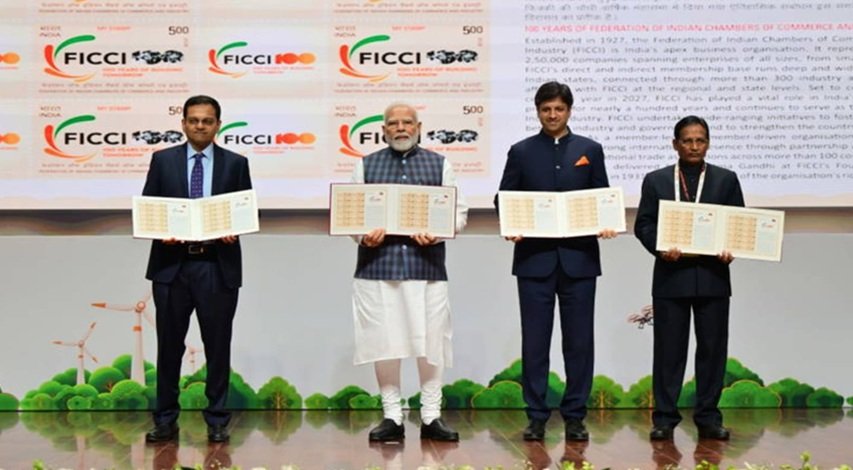
FICCI urged to look beyond its century of achievements and plan for the next 20 years
Prime Minister Narendra Modi has highlighted India’s status as the world’s fastest-growing major economy projected by major institutions to expand at around seven percent, alongside October’s record monthly goods exports of nearly US$50 billion.
He pointed out that the country’s economic performance has prompted global agencies to revise India’s growth upward. “Moody’s Ratings, S&P Global Ratings, Fitch Ratings, the World Bank, and the Asian Development Bank are revising our growth upward,” highlighted PM Modi at the inauguration of Annual General Meeting and Annual Convention of the Federation of Indian Chambers of Commerce and Industry (FICCI) in New Delhi on 19 Nov.
Addressing the gathering on the centenary celebrations of the FICCI, he noted that while he has attended FICCI events on several occasions earlier, today’s milestone is special as the chamber completes 100 years of staying alert, evolving with changing times, and contributing to India’s economic journey.
The Prime Minister urged FICCI to look beyond its century of achievements and plan for the next 20 years amid global resource weaponization so that Indian industry strengthens self-reliance and unlocks new business growth. “In every long-term investment decision of yours for the next 20 years, make India First your foundation,” asserted PM Modi.
Pointing out that although India is known globally as the Pharmacy of the World and excels in finished medicines, it still imports billions of dollars worth of APIs, bulk drugs, and drug intermediates across hundreds of categories, the Prime Minister urged the pharmaceutical sector to identify domestic manufacturing opportunities and invest in new technology and large production plants to gain global competitiveness. “In finished medicines, we have a strength, and now we will have to build our capability in ingredients as well,” he asserted.
Highlighting similar gaps in iron, steel, and aluminum, where India exports iron ore worth thousands of crores and holds vast bauxite reserves yet imports finished steel, specialized aluminum alloys, and other products, the Prime Minister called on industry to identify imported grades, develop manufacturing technologies, and build expertise across the mineral value chain. “We will have to develop the manufacturing capacity for these products in the country as well,” asserted PM Modi.
Noting that India’s share in global agricultural exports stands at just two to two-and-a-half percent despite its scale while processed food’s share in agri-food exports rose from 13 percent to over 20 percent over 12 years, the Prime Minister urged industry to draft a joint strategy aligned with global demand, expand investment in agriculture, and build dependable procurement and product lines for overseas markets. “Together we will have to change this situation and view it as a big opportunity for value addition and the food processing industry,” asserted PM Modi.
Pointing to untapped potential in daily engineering products, where India’s share in global hand tools and power tools exports remains low, and in machinery manufacturing for developing nations and the Global South, the Prime Minister encouraged large firms to help smaller enterprises scale up quality manufacturing and explore packaging equipment, irrigation systems, and factory machinery markets. “We can work on this sector to increase our presence in the global market,” remarked the Prime Minister.
Emphasizing that a nation progresses by honoring farmers, small entrepreneurs, industry, wealth creators, and taxpayers, the Prime Minister detailed pro-business and taxpayer-friendly reforms including cutting the basic corporate tax rate from 30 percent in 2014 to 22 percent, exempting income up to 12 lakh rupees to boost purchasing power, simplifying returns and refunds, and lowering GST rates on numerous goods to stimulate demand. “Its direct benefit is going to our industry and business houses,” observed PM Modi.
Encouraging industry to leverage India’s recent trade agreements and the Reform Express momentum to capture overseas opportunities alongside the 140-crore domestic market, the Prime Minister kept government doors open for suggestions while urging businesses to invest in understanding global customer needs, meeting standards, and building distribution networks, before concluding his address with best wishes to all participants. “Our domestic market should not be our comfort zone, as it must give us the confidence to compete in global markets,” asserted PM Modi. Fiinews.com